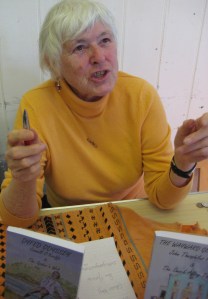
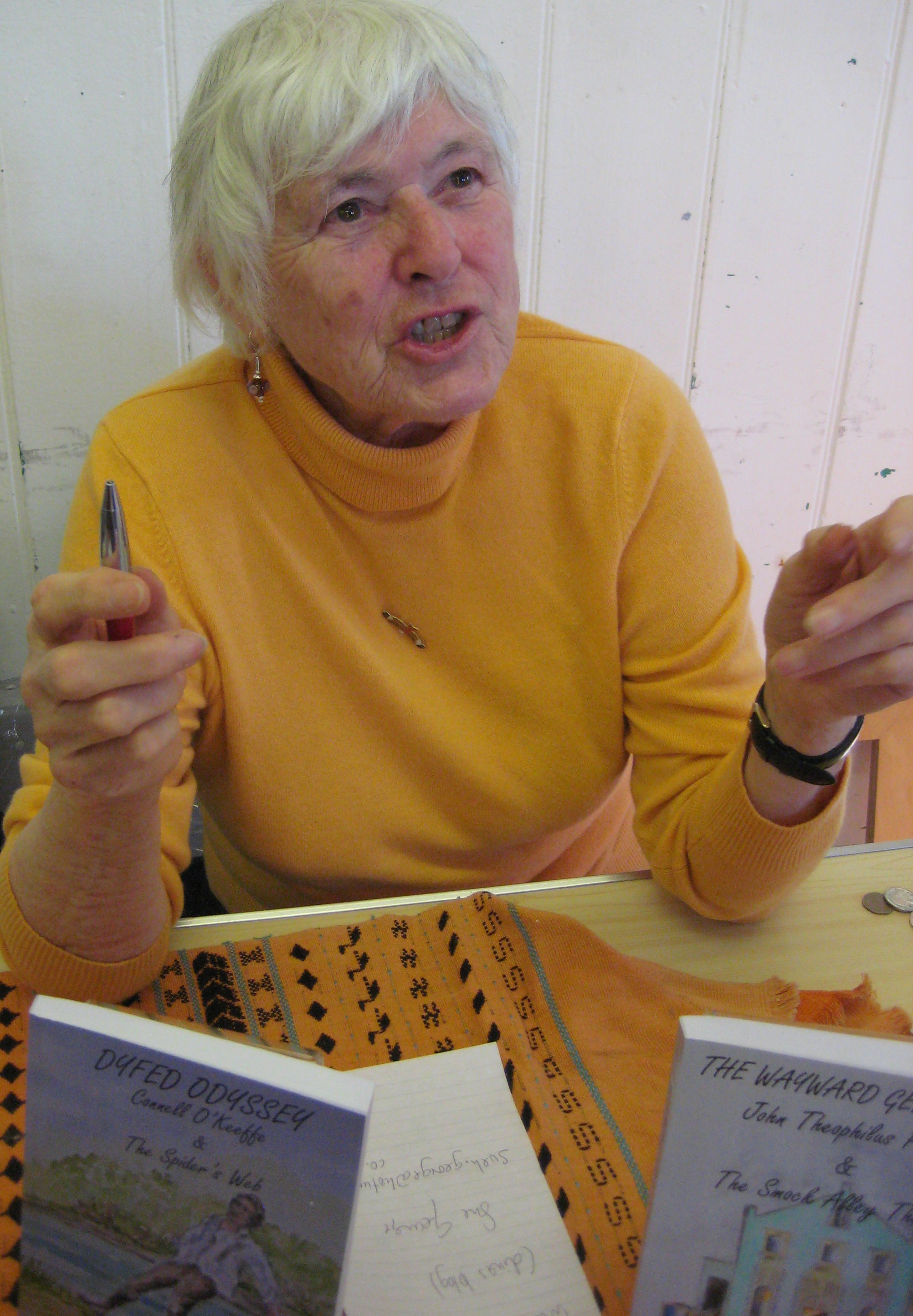
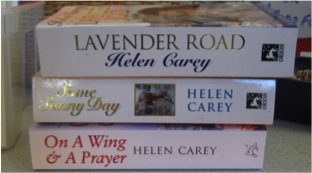
 Our local author, Patricia Watkins, comes from a literary family, but started writing in earnest when inspired by the characters she discovered in her family tree.
Her research into the ‘Potter’s of Haverfordwest has lead to a new career and the publication of several books set in North Pembrokeshire.
Here is an account of the life of her great-great-great- grand-father, an extended version of which was published in Pembrokeshire Life, January 2012. It offers an interesting insight into the history of our part of Pembrokeshire in the 18th century and may entice you to a further reading of Patricia’s novels.
The Life and Times of JOHN THEOPHILUS POTTER (1752-1839)
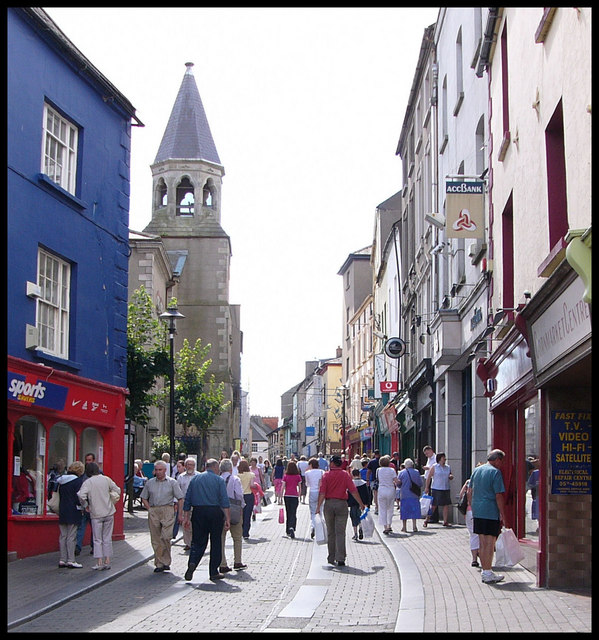
It was in about 1778 when a twenty-six-year-old actor from Dublin first arrived in Haverfordwest, deemed one of the most elegant towns in Wales at the time, all whitewashed, clinging to the steep hillside, with the graceful shingle spire of St. Mary’s Church piercing the sky at the top of High Street.
His name was John Theophilus Potter, and he had come to town with a troupe of actors to entertain the people of Haverfordwest. There was no theatre in which they could perform, so their performances would have been held in either in the Town Hall, or maybe up at the Blue Boar Inn, an area of town where many of the gentry from the surrounding countryside had their townhouses. Here, he would have entertained such people as Lord Kensington, an Edwardes, whose family seat was in Johnston, near Milford, and who owned a townhouse near St. Mary’s.
It is not known to which theatre company Theo belonged. He would not, however, have been one of those who went around the country, ranting at fairgrounds. Acting at that time, was a precarious occupation. Earlier in the century, satirist playwrights had been lampooning the government which, in retaliation, passed the Licensing Act, preventing any play from being performed in anything but a licensed theatre. Exceptions may be made by individual magistrates, who could, but frequently did not, give their permission for a performance to be held in their town. The effect on actors was disastrous, leaving many destitute, their woes increased because if they were caught without any money in their pockets, they would be charged as vagabonds and thieves, and thrown in jail. On the other hand, many of those in licensed theatres like Drury Lane, such as David Garrick and Sarah Siddons, became the celebrities of their time.
Dublin, being a highly cultural city, had several theatres, one of them being The Smock Alley Theatre, where Thomas Sheridan, Richard’s father, was actor/manager. I should like to think that Theo belonged to this company, which did have troupes that visited Wales. I have not found his name on the playlists of this particular theatre, however, although there was another actor by the name of Potter, a relative perhaps, performing there at the time. Being in the theatre in Dublin, Theo would have been acquainted with many of the famous actors of the time, all of whom commuted regularly between the London theatres and those in Dublin.
Their commitment in Haverfordwest at an end, it was time for Theo’s troupe to leave. In the meantime, however, he had fallen in love with a local young lady. Her name was Elizabeth Edwardes, and it is said that ‘he married well’.
Elizabeth’s father, Joseph Edwardes, like Lord Kensington, also came from Johnston, and he and his wife, Eleanor Morris, were married in Steynton. Records do not go back far enough to be able to prove it, but the origins of her parents and the spelling of Elizabeth’s last name, along with her highly-educated signature on her marriage entry, lead one to believe that she was almost certainly related to the Kensington family.
By all accounts Theo was a very charismatic man, humorous and witty, capable and hard-working, the latter being described as being ‘of industrial proportions’. It is obvious that he too was well-educated. (There are those of his descendants who claim he was the grandson of John Potter, the Archbishop of Canterbury. I myself, do not believe this.) Whatever the case may be, however, his admirable qualities were such that the young actor very quickly made many influential friends, something that no doubt also helped him secure Elizabeth’s hand in marriage. They were married in St. Martin’s Church in Haverfordwest – – a church described at the time as being, ‘old, ugly and wretched’ — on June 27, 1779.
Where in town the couple lived right after their marriage, is not known, but it is highly probable that they rented one of the many properties owned by the common council. If this was the case, then, apart from his rent, it would have been up to Theo to provide the current mayor with two fat chickens each year as well, and Theo, being Theo, surely would have had fun commenting that, considering the large number of properties owned by the council, the mayor must have been be inundated with fat chickens!
His acting career coming to an end now he was in Haverfordwest, Theo set about finding something on which to expend his energies, and before long opened up a printing business on High Street — the town’s first — a business that was still in existence over seventy years later, being run at that time by the widow of Theo’s son, Joseph, and at one time employing eight men at the then 46 and 47 High Street. Theo also opened a reading room — for the gentry — and a lending library. It was in Theo’s lending library that the young actor and entertainer, Thomas Dibdin spent an afternoon composing a song, which he later that evening sang for his Haverfordwest audience at a special benefit performance.
Such were Theo’s energies that he was made a burgess of the town at the age of thirty-five, and three years later was pricked for sheriff. The sheriff at that time was elected by the common council from a list of possibilities put forward by the burgesses of the town. The council would then choose their preferred individual by making a prick with a stylus next to his name.
How Theo felt about being elected sheriff we can only imagine. Apart from the demands upon his time — he was on call at any time of the day or night — there were considerable demands on his finances as well, yet, once pricked, it would not do to refuse. (One man had done so, and was fined forty shillings because of it, the money being used to refurbish the whitewash on St. Mary’s Church steeple.)
Most certainly the greatest expense he would have faced would have been the festivities surrounding the Whit Monday parade. On this day, it was the sheriff’s duty to provide, out of his own pocket, a magnificent breakfast for all the local dignitaries surrounding the council, about fifty people in all. It is told that by the time the ‘breakfast’ was over, many of the dignitaries had difficulty staying on their mounts during the parade that followed …
On the plus side, it was his privilege to select the jailer, and this was around the time that John Howard, the prison reformer, was touring the whole country, advocating changes in the way prisons were run. Many jailors were unscrupulous, demanding payment from prisoners for all their needs, often refusing to release them until they had paid off their debt to him, despite their original sentences having already been served. Howard had come to Haverfordwest on two occasions, and had certainly not found things to his liking on one of them. Maybe Theo took his complaints to heart, and tried to improve the prisoners’ lot by selecting an honest jailer. I should like to think so.
Another plus for him was that there were no elections that year, saving him from being put in the position of having contestants try to bribe or intimidate him into influencing the outcome — seemingly a common occurrence, the sheriff sometimes standing at the door to prevent the opposition from entering to cast their vote.
As sheriff, Theo would have had a number of specific duties, and no doubt one of his favourites — being still in his thirties at the time — would have been kicking off the annual Shrove Tuesday football game. In the past, the townsfolk had celebrated this day with violent and bloody cock fights and bull-baiting events, but by the time Theo became sheriff these had been replaced by the football game — being considered less violent and bloody, although one has to wonder, when shop owners around town found it necessary to barricade their storefronts ahead of time to protect themselves and their property from the wild crowd charging through town, and crashing into their windows.
That year, in 1790, at noon as usual, it would have been Theo who would have stood in St. Thomas’s square, and kicked the new football into the air. This kick would start the game. On one occasion, it is claimed, the ball had been kicked so high it had travelled all the way down Market Street, landed on St. Mary’s steeple, then bounced off, ending up in Dark Street. The game would continue — with the whole town acting as the playing field — until it was too dark for anyone to see the ball anymore. Theo, I think, could hardly wait to take part in the free for all.
Theo would also have had special duties when the assizes came around. Given his amiable and sociable nature, he would have enjoyed some of the events, for this was when balls were held at the Town Hall three nights in succession, Lord Kensington being responsible for the first, Lord Milford for the second, and the mayor for the third; and he would have surely been happy to attend all three. Probably much less to his tastes, given what would appear to have been his restless nature, would have been the onerous duty during the assizes of having to stand on the left-hand side of the judge throughout the actual court procedures, while the County Sheriff stood on the judge’s right, and perhaps most detested of all, the necessity for having to preside over the Hundred Courts, held twice during his year of office, and covering petty crime and misdemeanours.
As a burgess of the town, it would have been Theo’s obligation to take up arms in defence of the town, and he is said to have been with Lord Cawdor at the time of the surrender of Tate’s French forces in Goodwick on February 23, 1797. Theo, by this time would have been forty-five.
During these years, Theo had been busy otherwise as well, and by 1799, Elizabeth had borne him thirteen children, eleven of whom survived, her youngest, Thomas, being my ancestor. One could argue that Elizabeth could well have died in childbirth, but when she died in 1804 at the age of forty-seven, she had borne no more children in the previous five years. It is known from the letters of Lieutenant John George, son of Stephen George, proprietor of the Blue Boar Inn, and best friend of Theo’s eldest son John, that the latter suffered from eye problems.
Although little has been said about this, Theo had obviously never lost interest in the theatre, and when he discovered his son Joseph had a talent for acting, he nurtured it, and it is suggested that a play produced in Tenby in 1802, and attended by Lord Nelson and Lady Hamilton, was performed by Joseph’s theatre company, considered one of the three most important theatrical companies in Wales in the early years of the nineteenth century. Joseph’s own playhouse was opened in Aberystwyth in 1833, and he even took his company to Ireland, where, in Wexford, the people thought so highly of him, they promised to build a playhouse for him there as well. When his company finally disbanded in 1835, and Joseph was in his fifties, many of his best actors went on to form their own companies.
Three years after Elizabeth’s death, Theo married a widow by the name of Susannah Heath/Harmon in St. Mary’s Church in 1807. She came from the popular resort of Bath, where he probably met her. He was twenty years her senior, and the role of stepmother must have been very difficult for her, young Thomas being only five when his mother died, and Theo’s eldest child, John, only nine years younger than herself.
After their marriage, Theo bought a residence in Hackney, a small village at the time, but a centre for literary-, theatre- and politically-minded people. It is likely that many of Theo’s old acting acquaintances lived here too, and could well have been the reason he chose Hackney. Many of the more wealthy members of Pembrokeshire society had houses in London, including, of course, the Kensingtons, after whom Kensington is named, and where many of the streets are named after Pembrokeshire locations. Some have assumed that Theo left Haverfordwest at that time, and moved away to London. However, right up through the 1820s, whenever he subscribed to any new publication, he still gave his address as Tower Hill, Haverfordwest, so, like many of his local, wealthy contemporaries, he obviously spent part of the year in Haverfordwest, and another in London. Being ever industrious, Theo went ahead and opened a bookbinding and bookselling business in Hackney as well, Susannah still running the business until her death in 1845.
He and Susannah had seven children, and even in the 1890s members of the Haverfordwest branch of the family were still spending time in Hackney as well, even living there. One of Theo’s sons by his second marriage, Charles Potter, began Hackney’s first newspaper, The Hackney Gazette, a newspaper that remained in the Potter family until 1996, when it was taken over by one of the big newspaper conglomerates, and still exists. In their special centenary supplement, published in 1964, when Theo’s descendant, John Potter, was managing director, they pay tribute to Theo’s son Joseph, who, apart from running his theatre well into his fifties, and playing cricket for Haverfordwest, was as industrious as his father, having been sheriff three times, mayor once, and proprietor of the Pembrokeshire Herald. Joseph, alas, appears to have been too industrious for his own health, and died after a stroke, at the age of sixty-three, only seven years after his father.
The Potters went on to run newspapers all over the world. Potter’s Electric News was published in Haverfordwest between 1855 and1869, while family members published newspapers in Australia, Ireland and, as mentioned above, in Illinois, where descendants of Theo and Elizabeth’s eldest son, John, became proprietors of the Rock Island Argus, which remained in the Potter family until 1985. Interestingly, the qualities of John W Potter, who ran the Argus in the latter part of the nineteenth century are identical to those used to describe his great grandfather Theo.
Perhaps it is not surprising then that the Potters were described in 1896 as ‘a literary people’.
Theo died of old age in Hackney in 1839, at the age of eighty-seven, after a most productive life — in more ways than one — for which I am thankful, for without this other talent, I would not be here writing about him.
© 2012 Swan House Publishing Newcastle Emlyn, Carmarthenshire. 01239710632
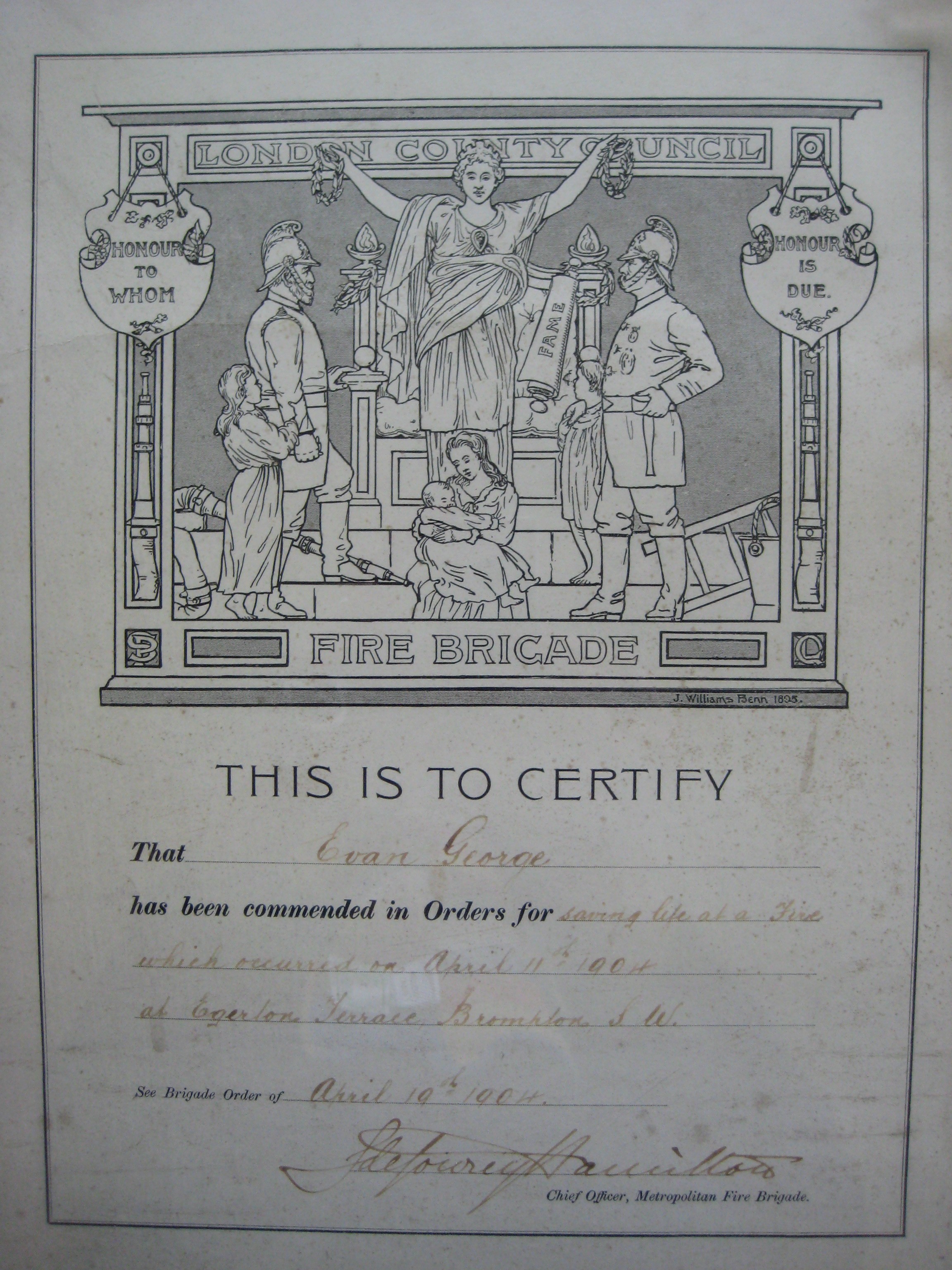 My Dinas grandfather became an economic migrant to London when his colour blindness put an end to his ambition in the merchant navy. In London he joined the fire service, where his daughter spectacularly survived a fall down the pole in Borough fire station, and where he saved lives and laid down the law on the subject of nightwear for the girls in the family. He knew too much about the horror of burns and he knew that it was often the little girls that suffered – so no flouncy, silky nighties for us.








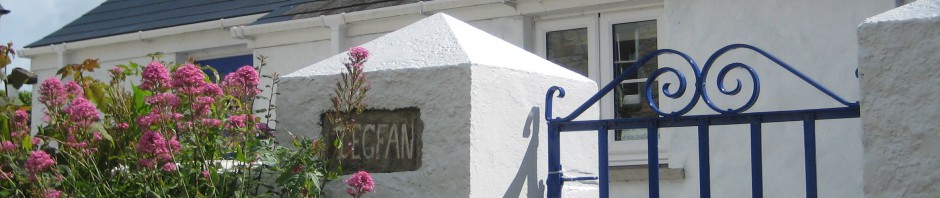
 Tegfan, Dinas Cross