A rarity

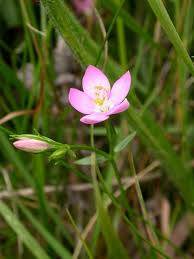
Perennial CentauryThe Perennial Centaury (Centarium scilloides), which flowers in June, was thought to have only one native habitat in the UK – Newport Dunes. It has recently also been seen in Cornwall but it remains an exciting find.

It grows on the Atlantic coasts of Portugal, Spain and France but it is a rarity in the UK. Its seeds can survive for a couple of weeks in sea water and that may account for its distribution to our Western coastal areas. The dunes at Newport have a richness of wild flowers. Tread carefully!

Photo from http://www.bradfordbotanygroup.co.uk/Pembrokeshire.htm

Posted in Nature, Sea, Walking, Wildlife | Tagged , , , , | Leave a comment

Teachers in the family

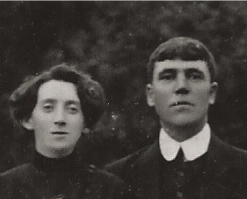
Paulina and TomThe first was Paulina George who was employed as a pupil-teacher at Dinas County School. By 1903, aged 19 she had been promoted to ‘assistant’ and earned £35 per annum. She made a significant contribution to the school by introducing Welsh-medium education to the Infants. This was one of many improvements to education in Dinas under the direction of the new Head Teacher – Tom Maurice – whom she married.

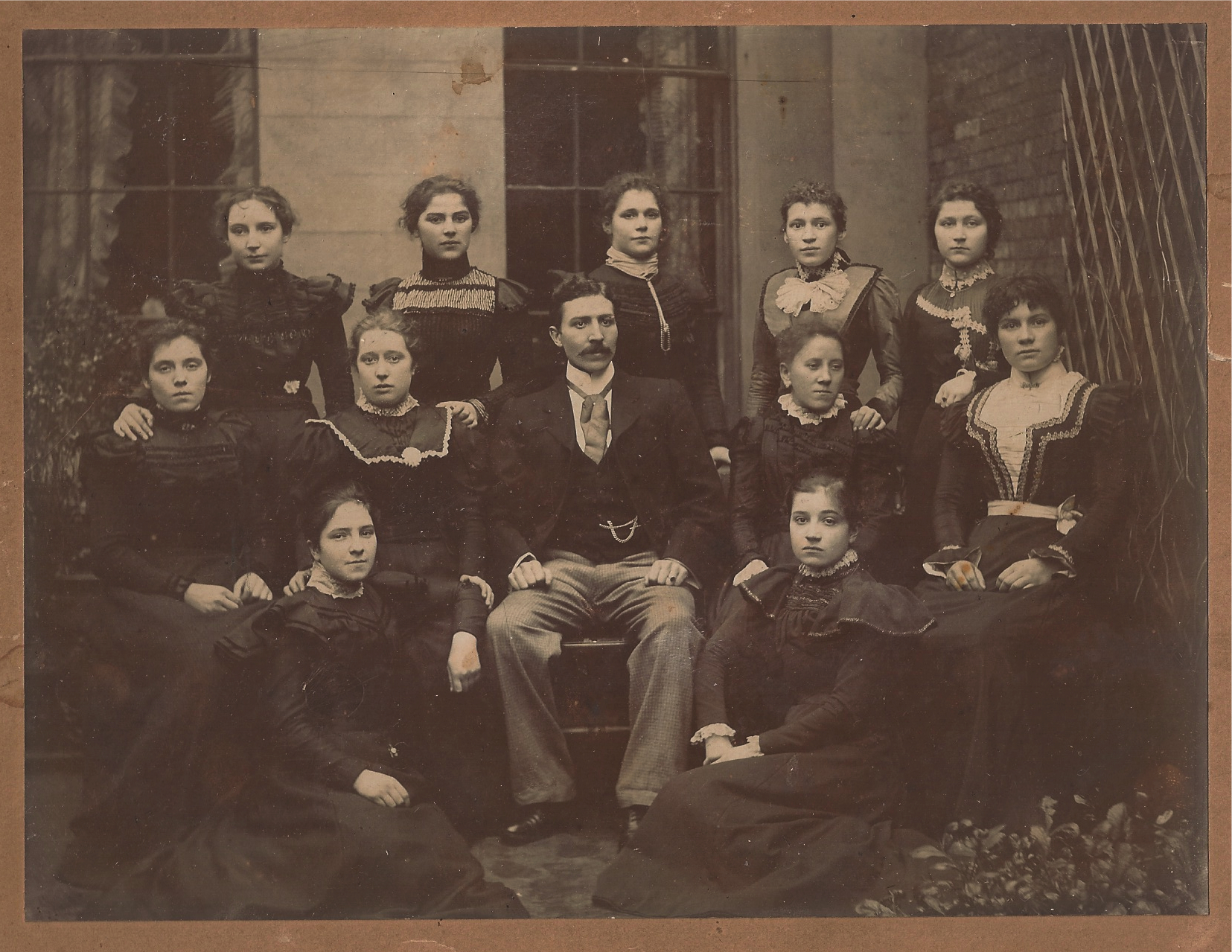
Next came Mary Anne Harries who married Paulina’s brother, Evan George, my grandfather. Although her family originally came from Dinas, they had settled in Swansea and here she is (at the front, on the left) at school, or maybe at college.

Mary Anne Harries at school or teacher training college SwanseaAnd here she is again. This time she’s working as a teacher in Swansea and has a class of her own. Are the girls surly, unhappy or just from an era before we learnt to smile for the camera?

Brynhyfryd Girls School Group 5 with their teacher Mary Anne Harries.

Brynhyfryd Girls School Group 5 with their teacher Mary Anne Harries.

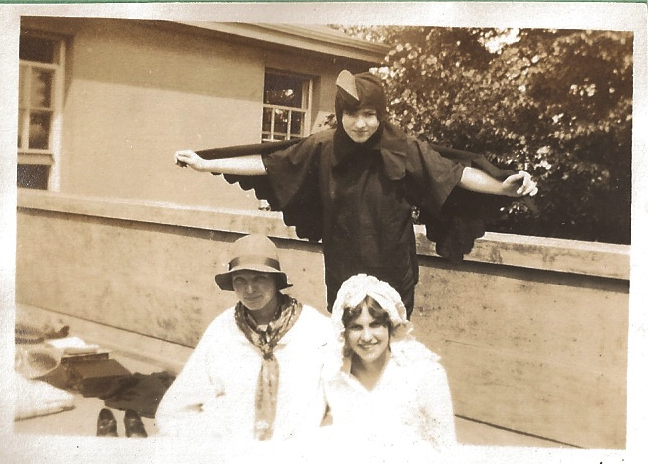
The couple moved to South London where their eldest daughter, Eva(ngeline), also became a teacher, training at Avery Hill College in the 1920s. This photo, taken in 1926 on the roof of Roper Hall, shows my aunt Eva dressed as a blackbird. Is this a sign that education was becoming more fun?
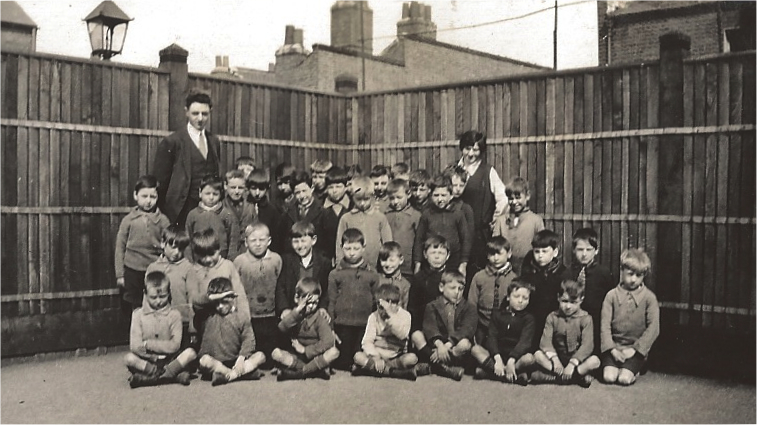
Eva as a blackbird on Roper Hall roofTeacher training at Avery Hill, a new college for women, was thorough and progressive, although it didn’t include science in the curriculum until the 1930s as so few of the trainee teachers had studied it themselves at school. There was teaching practice, however, and here is Eva with class standard IV on ‘Senior School practice’ at Union Street School Woolwich.

Union Street School Woolwich. Class 4

Union Street School Woolwich. Class 4. c 1928.

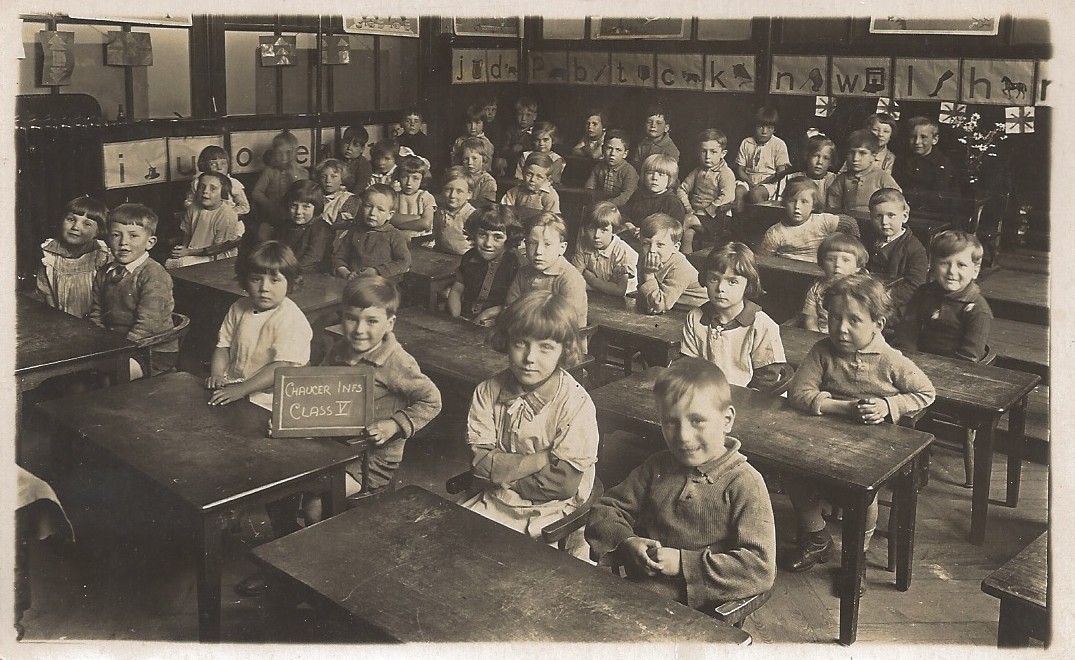
When she qualified, she went to teach at Chaucer Primary School in the 1930s,

Chaucer Infants Class 5

Chaucer Infants Class 5. 1930s.

English Martyrs Primary School during the war and Joseph Lancaster Primary School from the end of the war to her retirement in the 1960s.

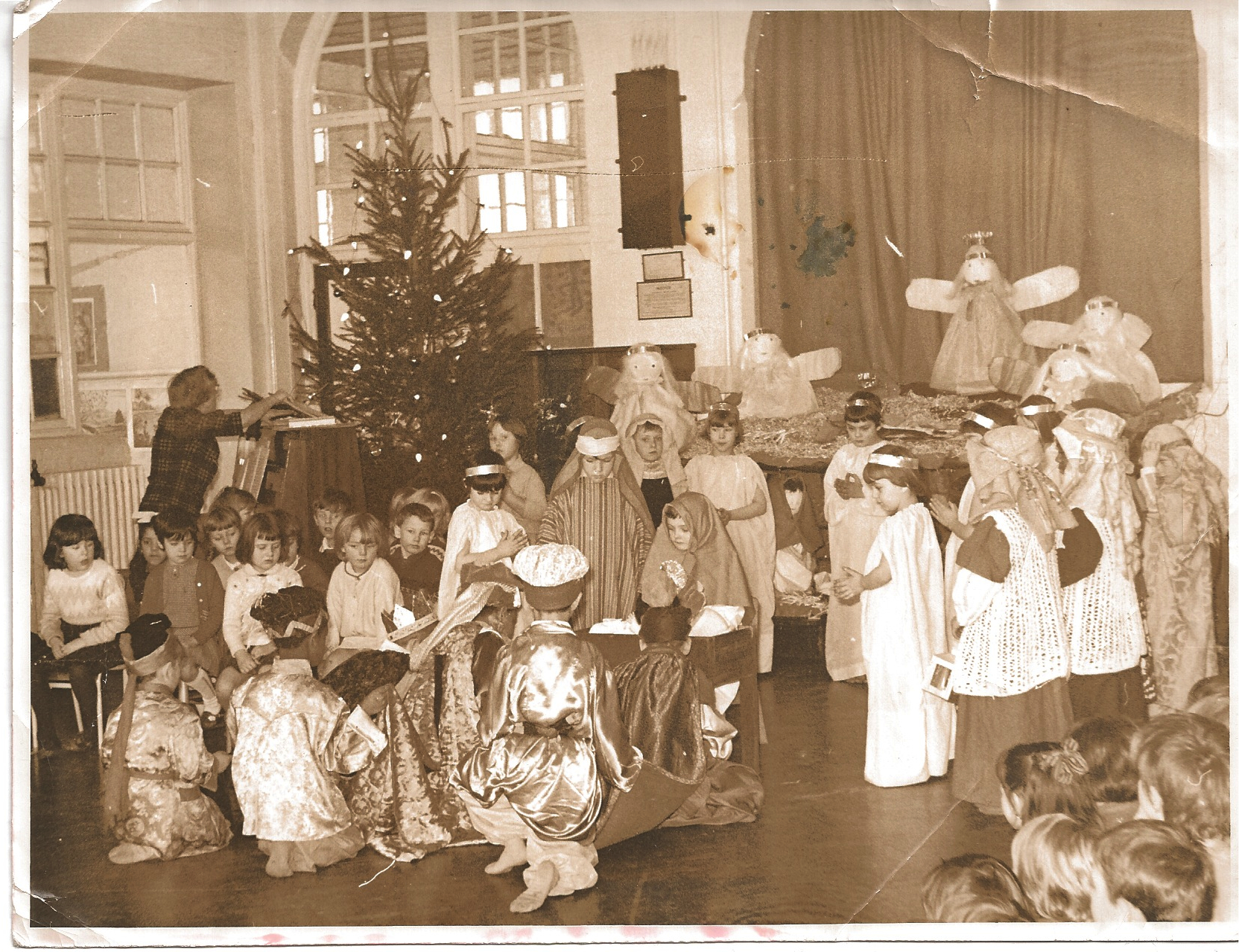
Joseph Lancaster Infants School

Joseph Lancaster Infants School c 1960. Eva George at the piano.

She loved her work and in spite of class sizes that were often 50+ prided herself that all the children had learnt to read before they went up to the Junior School.

Posted in History, Welsh language | Tagged , , , , , , , | 2 Comments

Down to the sea

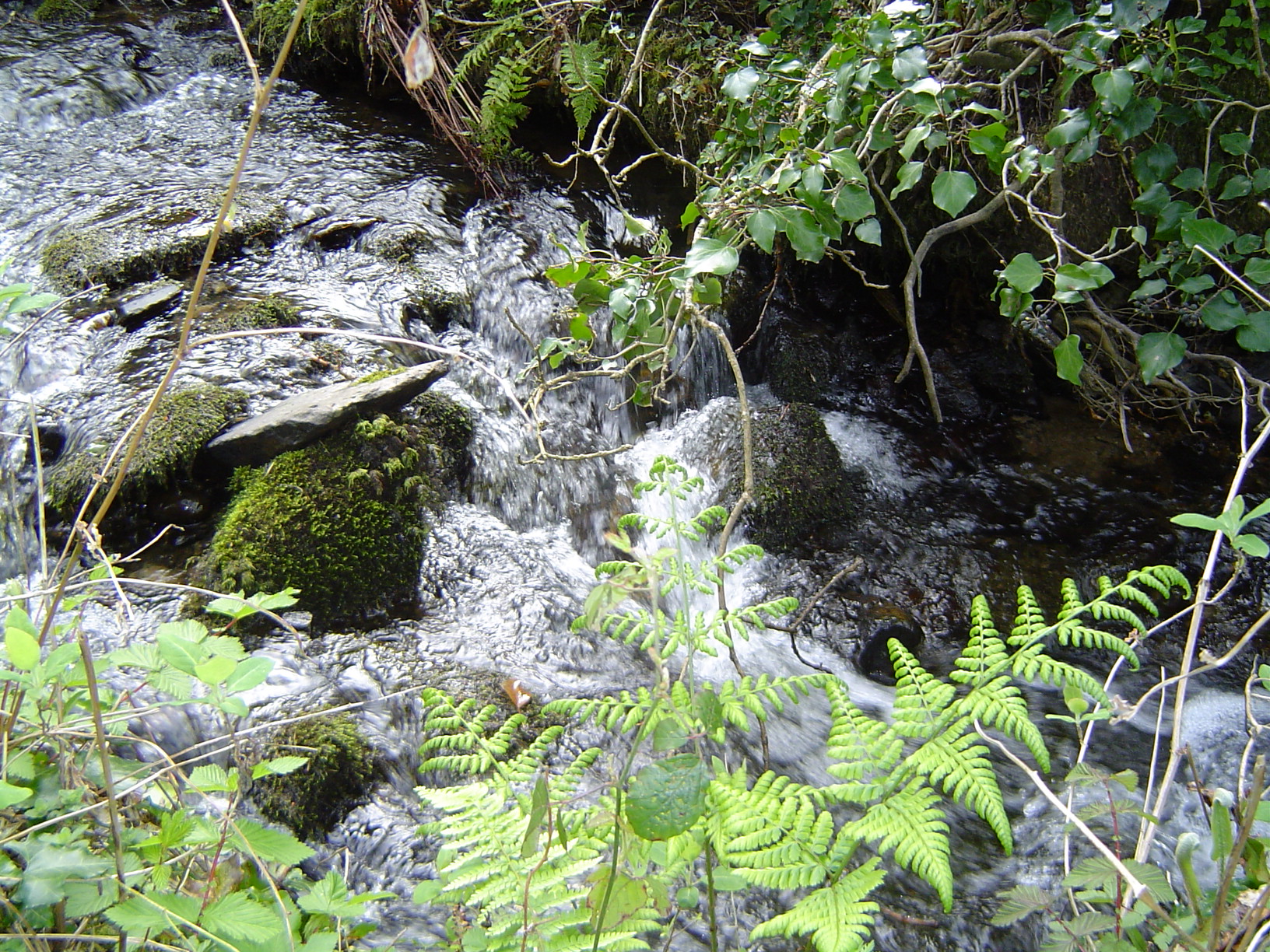
Stream at Dinas

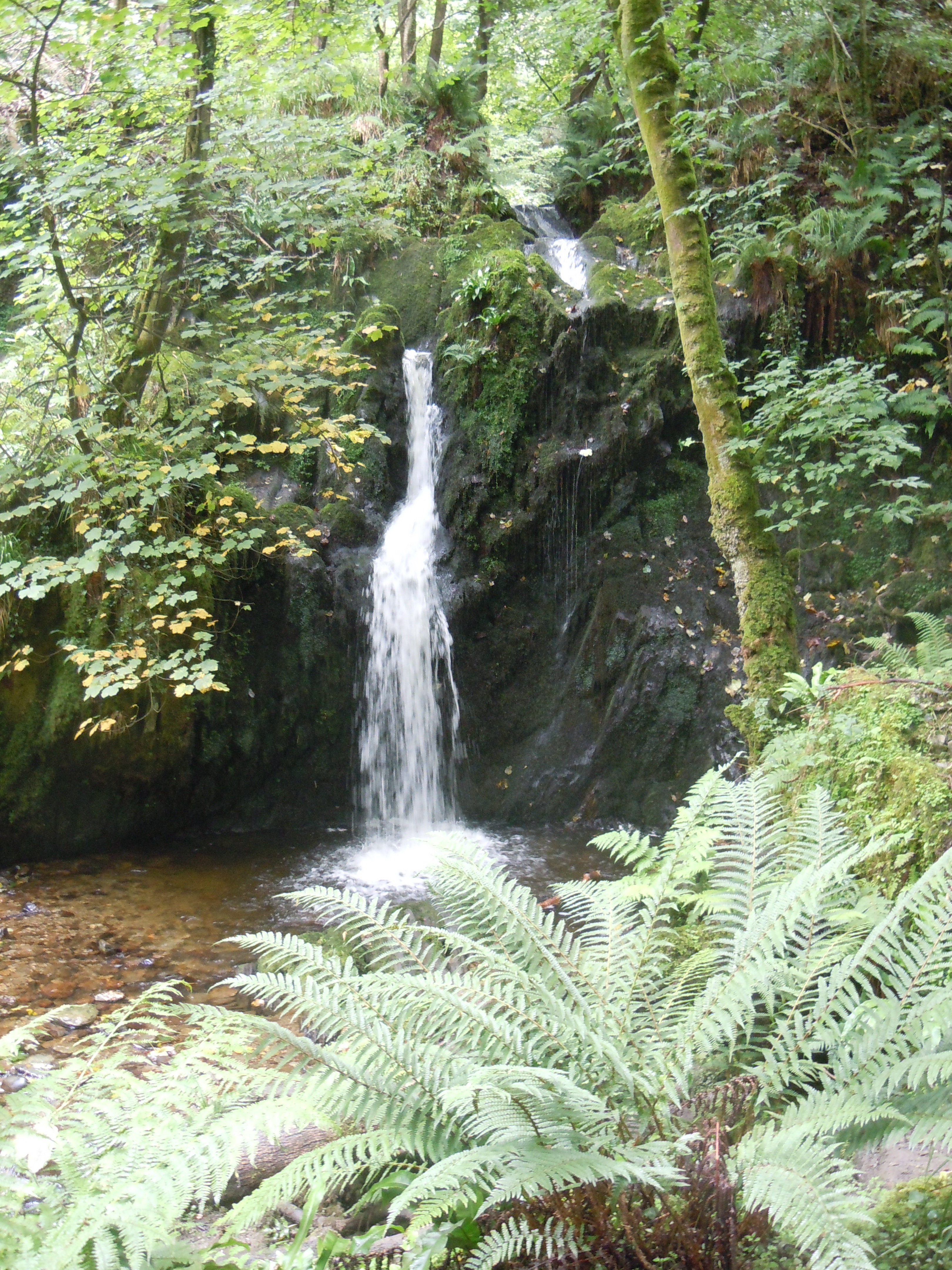
Each of Dinas’ beaches is fed by a stream that rushes water down from the mountain. This torrent ends up in Aberbach whereas if you follow the valley to Aberfforest you’ll find that the water drops from a rocky height to the sandy stream bed.

Aberfforest Falls

Photo credit Heather Hill

When the stream finally crosses the beach and before it reaches the sea, there are wonderful opportunities for children to divert the water and make canals, pools and bridges that will last until the next high tide.

Posted in Nature, Sea, Walking | Tagged , , , , | Leave a comment

All in black and white

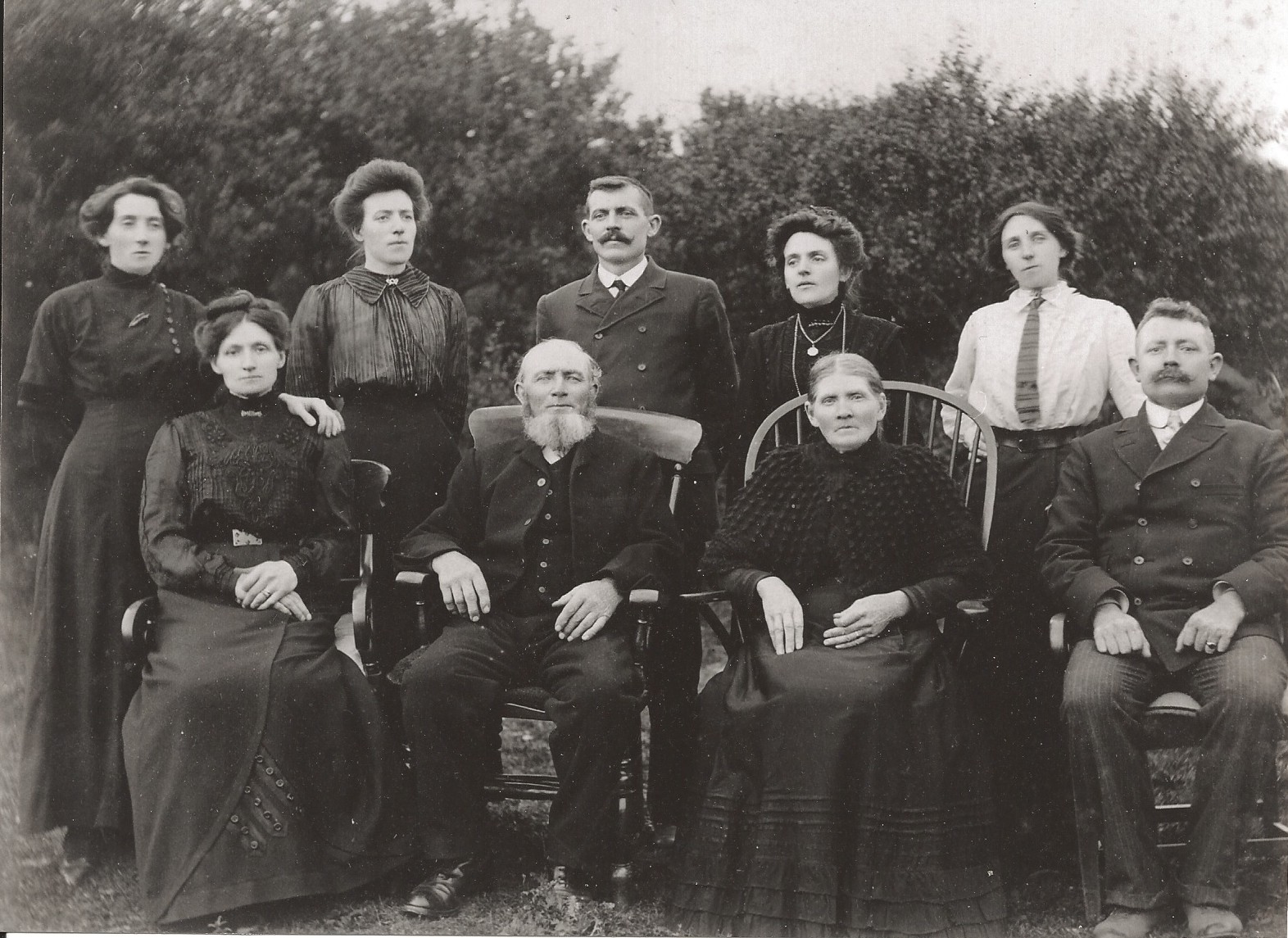
Stephen, Mary and their children

The run-away marriage of Stephen George and Mary George in 1866 produced a large family of seven girls and three boys.

This photo was probably taken about 1914 at Bank House, Dinas, and David George (died at sea), Hannah Jane (died of typhoid) and Sarah (died aged 5) are sadly just memories.

The two boys by this time were firemen in London but the girls had all settled locally. They all appear to be wearing black – frills, lace, flounces –  and I’m guessing that, with the possible exception of Rebecca’s tie, there’s not much colour there. I only knew my great aunts in old age and I’m sorry that this photo doesn’t show if any of the children inherited their mother’s red hair.

(Starting from the left
Back row: Paulina/Polly,  Miriam,  Evan,  Elizabeth,  Rebecca,
Front row: Martha Ann,  Stephen (Pater Familias),  Mary,  William)

Posted in History | Tagged , , | 4 Comments

Glorious colour

Tegfan June 2015

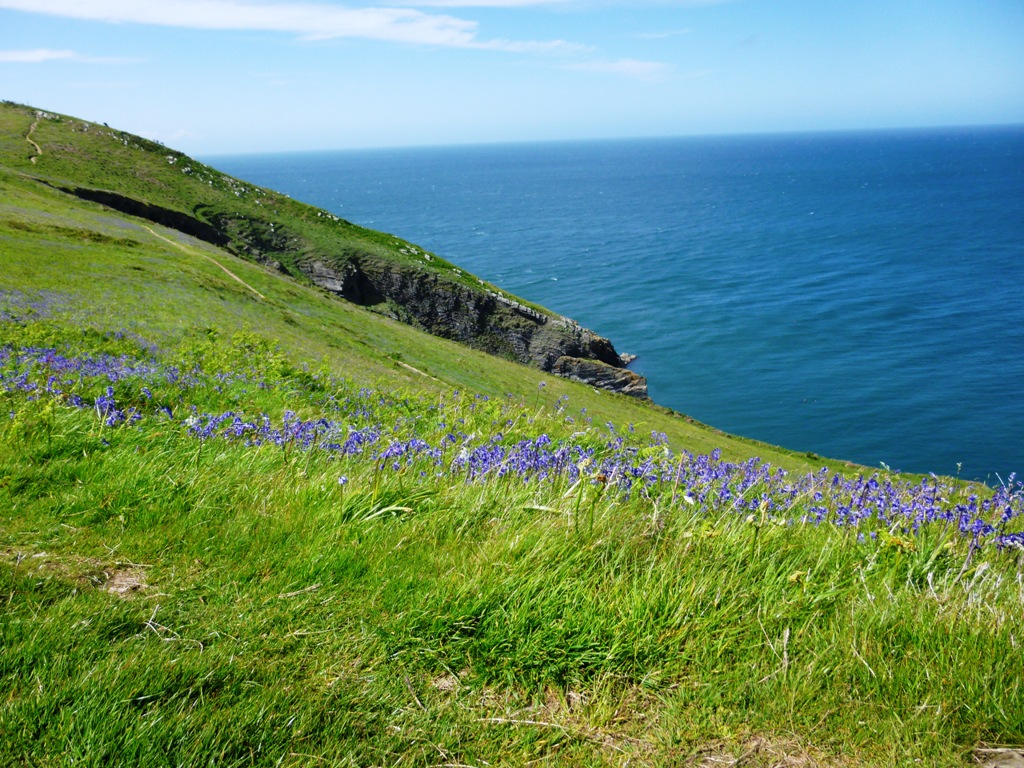
Bluebells at the Cwm yr Eglwys end of the path round Dinas Island. Photo credit Gareth Jones.

Posted in Nature, Walking | Tagged , , , , , | Leave a comment

Frozen to death

Many of Dinas’ young men were employed on tramp steamers – ships that had no fixed schedule or itinerary but were chartered to carry goods as and where needed. David George, from Hescwm, made his final voyage at the age of 25 in November 1892. He was working on the ss Greystoke, a tramp steamer carrying grain from Odessa, a major seaport on the Black Sea, to Hamburg, on the river Elbe in Northern Germany. Odessa to Hamburg

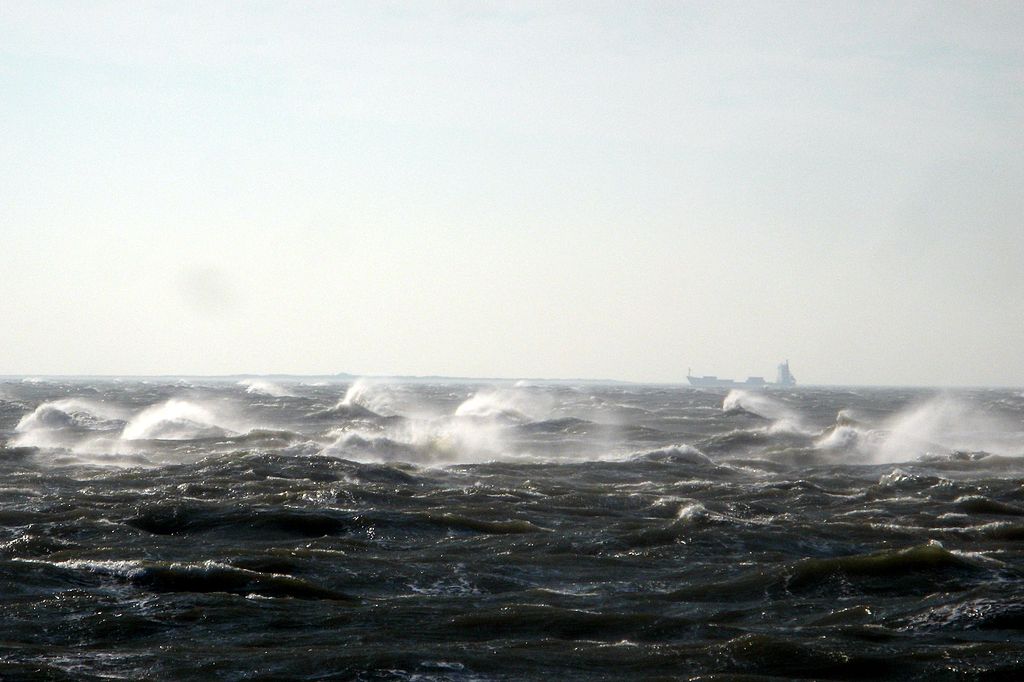
Grosser_vogelsand_

The broken waves indicate the presence of the sandbank

They had nearly come to the end of their voyage when their ship ran aground on the Grosse Vogel sandbank near Cuxhaven. This is one of two treacherous sandbanks at the estuary of the River Elbe where the combination of frequent storms and high seas  with very fine sand that holds any ship that runs aground until is is broken up by the waves have accounted for numerous shipwrecks.

In recognition of the dangers, Cuxhaven now has a large coastguard and life boat station but you can still see the wreck of the Ondo from 1961.

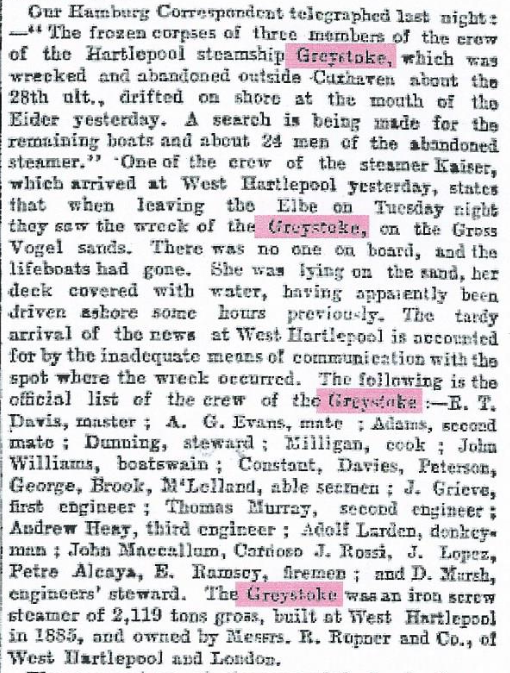
When the SS Greystoke ran aground the crew abandoned ship and took to the life boats. The tragedy was reported by the Hamburg correspondent of ‘The Times’.

Screen Shot 2015-06-04 at 22.50.55 David George died of exposure in an open boat and was buried in the ‘Welt’ Cemetery in Schleswig-Holstein but his sad early death is also remembered in Dinas’ Machpelah graveyard.

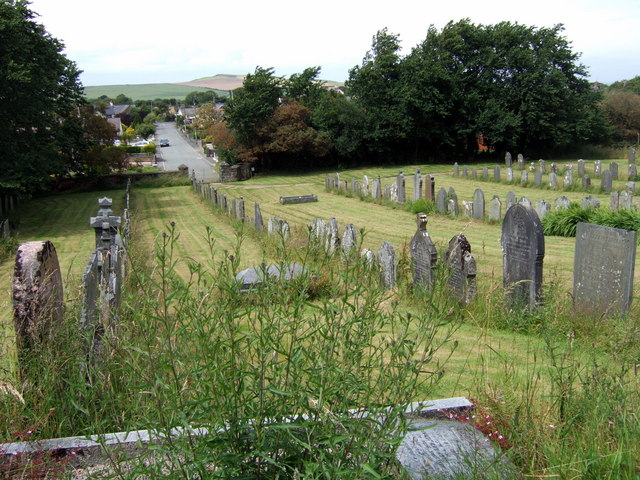
Machpelah cemetery The cemetery here, which is associated with Capel Tabor, was opened in 1834 and enlarged in 1906. Set on hillside above the village, it has a view across to Dinas Island and the sea to the north, very appropriate to the number of mariners buried here.  © Copyright ceridwen

Machpelah cemetery
The cemetery here, which is associated with Capel Tabor, was opened in 1834 and enlarged in 1906. Set on hillside above the village, it has a view across to Dinas Island and the sea to the north, very appropriate to the number of mariners buried here. © Copyright ceridwen

Posted in History, Sea | Tagged , , , | Leave a comment

Help me discover why 1897 has disappeared.

I want to know what happened in 1897 in Dinas.

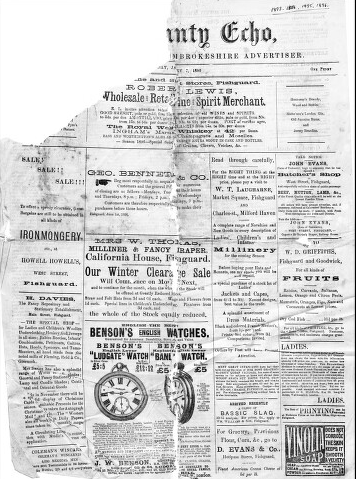
It was Queen Victoria’s Diamond Jubilee Year and the year that Hannah Jane George died of typhoid  but the whole year is missing from the archived back copies of our local paper. How can that be? What happened in that year to suspend publication of the County Echo or to divert the back copies from their destined place in the British Library, where you can find all the years from 1894 – 1950 but where the sixth column of the catalogue shows that 1897 is missing.

Screen Shot 2015-05-29 at 10.01.53

The County Echo, Fishguard and North Pembs Advertiser, was founded in August 1893. Its first editor and owner was Levi Evans and the four page broad sheet, with a front page full of advertising, declared itself to be ‘Independent – religiously and politically’. It was priced at one penny and was published every Thursday from offices in Fishguard. Levi Evans continued in charge until 1926. His sons, Bryn, Llwyd, Austin and Yorrie, then took over the running of the newspaper, with Bryn Evans as editor.

The nearest I have got to 1897 was on  Welsh Newspapers Online  which claims to have a copy published on 7th January 1897. But when I looked closely at the top of this torn sheet I saw that the date read 7th January 1896. Such disappointment!

Screen Shot 2015-05-30 at 21.31.56

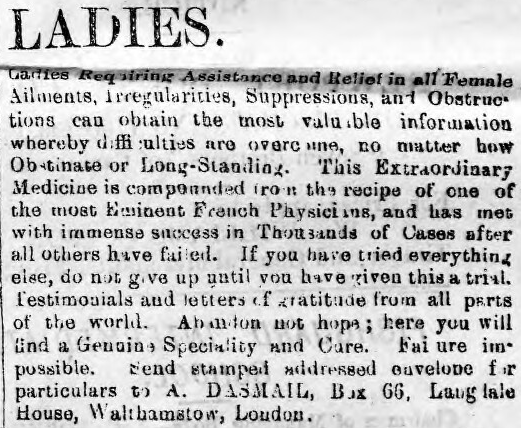
But this advertisement for a 19th century version of the morning-after pill did catch my interest.

Screen Shot 2015-06-01 at 22.30.43

Posted in History | Tagged , , , , | 1 Comment

4d to save a life.

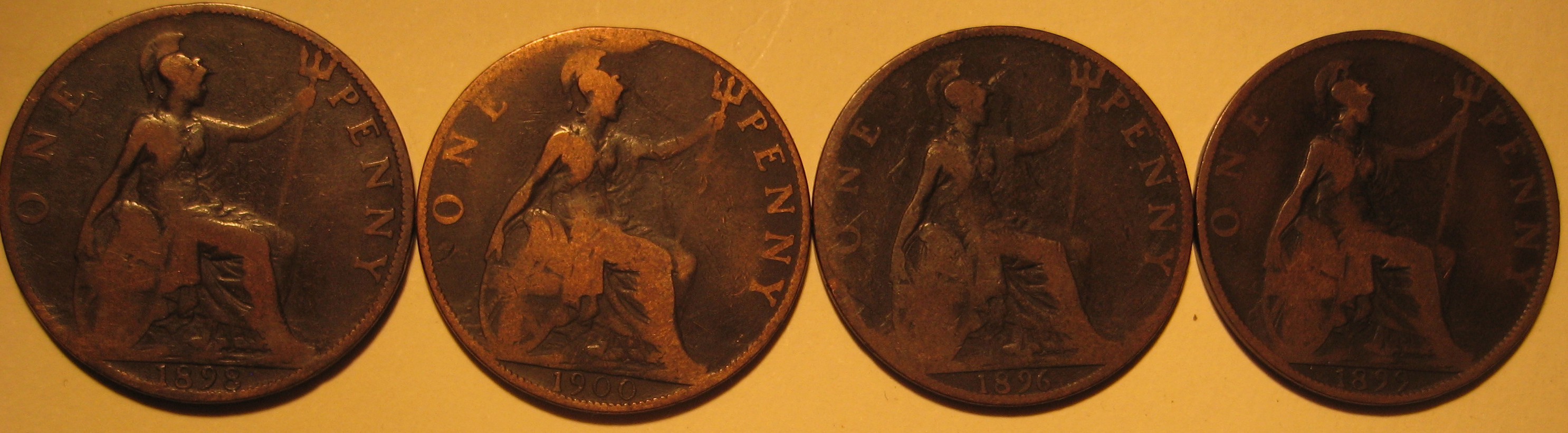
4d

4d

On September 5th 1897, Hannah Jane George (my great-aunt) died at the age of 24. She had contracted typhoid from drinking water from a well.  I don’t know what other sort of water she could have chosen to drink as there was no piped water in the village at the time.

By 1899, however, the Fishguard Water and Gas Company was looking to bring water and gas to Dinas, and the residents were perturbed. They could envisage the company having a monopoly, taking over all the springs in the village and increasing the rates of the parish that, according to local people , were already high enough.

On 15th February 1900 a meeting of the parishioners was held at the Board school. The meeting was very well attended and the villagers were reassured that the average weekly water rate would be 4d and the company would supply enough water for one water closet free of charge. Aware that parts of Dinas – Jericho, Cwmyreglwys and Brynhenllan – were short of water, opposition to the venture was withdrawn amid hopes that water would be piped to the village by the following summer.

Many of the pumps in the village remained, however. In the 1950s and 60s, there was a working pump in Feidr Fach, just along the path between Tegfan and the main road. There was also a pump on the main road – as there is now.
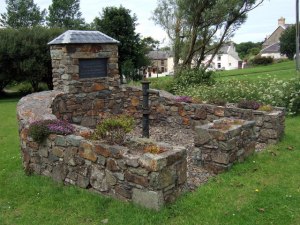
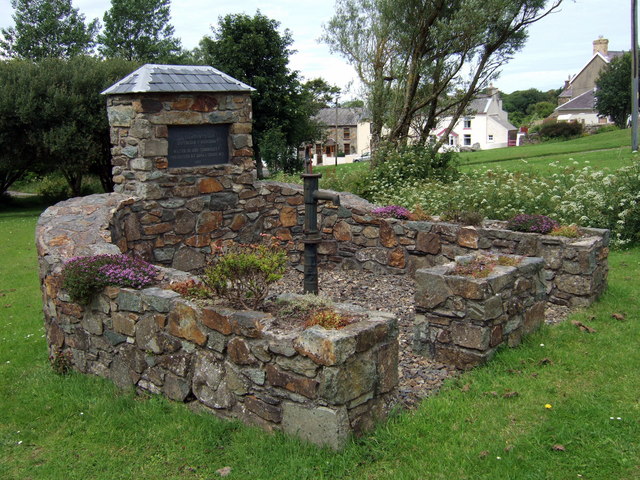
W I' pump Bwlch-mawr, Dinas

Pump at Bwlch-mawr, Dinas © Copyright ceridwen and licensed for reuse under this Creative Commons Licence.

The Inscription on the wall behind the pump reads:

DWR YN EIN CYMUNED A GYFLWYNWYD  GAN SEFYDLIAD Y MERCHED 

WATER IN OUR COMMUNITY PRESENTED BY DINAS CROSS W.I. 1993 

This pump, sadly, has never worked. If you walk along to the left for 100 yards or so, you’ll get to the spot where there once was a working pump that would splash water out into a bucket if you worked the handle.

This memorial, however, is a useful reminder not to take clean water for granted.

(For more information see ‘The News of Dinas 1894-1900’ transcribed from ‘The County Echo’ by Ann and John Hughes)
Posted in History | Tagged , , | Leave a comment

Built with a tiny carbon footprint

The old houses in Dinas were built with local materials. The stone came from quarries in the village and the the roof slates didn’t travel much further as there were slate quarries within a few miles.  Sand came from local beaches and, with its high salt content, it guaranteed damp walls for the inhabitants.

The seams of quartz that streak so brilliantly through the grey slate in the cliffs along the coast provided the decoration – or maybe a guide to the front door before the advent of street lighting.

Posted in History, Sea | Tagged , | Leave a comment

Pwnc (to rhyme with Nunc)

Being the child of a mixed marriage – mother from a Catholic background and father from a Protestant, non-conformist, family – I had thought that those two versions of Christianity were at opposite ends of a very broad spectrum.

But Whitsun (next Sunday) in Dinas proves me wrong as the local Baptist chapels continue a tradition that dates back to the ninth century. It is known that the people of Pembrokeshire were very reluctant to give up their Catholic faith and kept a lot of the old traditions. Welsh hymns to Mary were used in Cardiganshire long after the Reformation and although these are sung no longer, the Baptists in North Pembrokeshire still have ‘Pwnc’.

Caersalem - Cilgwyn

Caersalem – Cilgwyn

Jabes - Gwaun valley

Jabes – Gwaun valley

Tabor - Dinas

Tabor – Dinas

Bethlehem - Newport

Bethlehem – Newport

Pwnc to rhyme with ‘Nunc’, as in ‘Nunc Dimittis’, is a choral form peculiar to the tradition of a small number of chapels in this area. It comes from the Latin ‘punctus’, meaning a line of music and is an  ancient form that survives only locally. It clearly goes back to pre Reformation times when the Bishop would catechise candidates who were to be confirmed and admitted to The Mass. The music uses the simplest form of the old Gregorian chants, plainsong, with the tenors and sopranos taking the higher notes and altos and bass the lower notes.

Fifty years ago at Dinas’ Baptist Chapel, Tabor, even the gallery would be full at Whitsun, and every member of the congregation would have to sit with their age group – even adults.  Part of the service would involve chanting a chapter of scripture and then the minister would ask questions and the congregation would stand up in turn to give the answer which had been prepared in advance. There would also be hymn singing and an “anthem” which was a longer piece of music. Pwnc always takes place at Whitsun and now four Baptist chapels, Tabor in Dinas, Bethlehem in Newport, Jabes in the Gwaun Valley and Caersalem in Cilgwyn get together for the occasion.

Cymanfa Bwnc

Pwnc also survives in Maenclochog, as mentioned on this tourist information board in the village.

And finally to hear what Pwnc sounds like, click the link below.

http://news.bbc.co.uk/local/southwestwales/hi/people_and_places/history/newsid_8455000/8455329.stm

(Many thanks to Ann and John Hughes who provided much of this information.) 

Posted in History, Religion, Welsh language | Tagged , , , | Leave a comment

A farmer at Hescwm

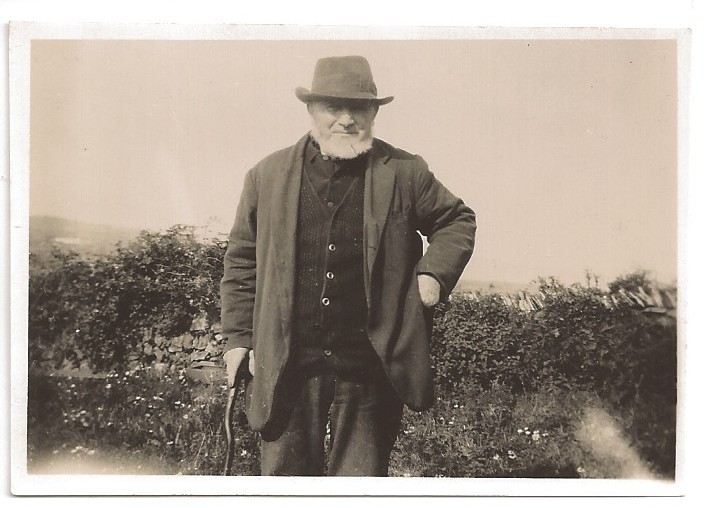
This is the only photo I have of my great-grandfather, Stephen George, standing alone, in his soft, comfortable, everyday clothes.  The other photos that have survived show him as a ‘pillar of the community‘ or ‘pater familias’ –  his place in the group determined by a photographer who knew the importance of age, height and status and arranged his subjects accordingly.

In this informal photo I love the ease of his knitted waistcoat with the mismatched buttons and the wear on his jacket. Did he keep a pipe in his breast pocket and is he hiding it away for the photograph? Did he need the stick to steady himself or was it just a useful tool when he went walking in the country side? I wish I had known him.

I don’t know exactly where this photo was taken. He appears to be looking into the sun and maybe has his back to the sea. He farmed at Hescwm and then retired to Bank House, where he died in 1933 aged 91. I expect that the photo was taken at the Fishguard end of the village.

Posted in Farming, History, Nature, Walking | Tagged , , , | Leave a comment

From Hescwm to London via Swansea

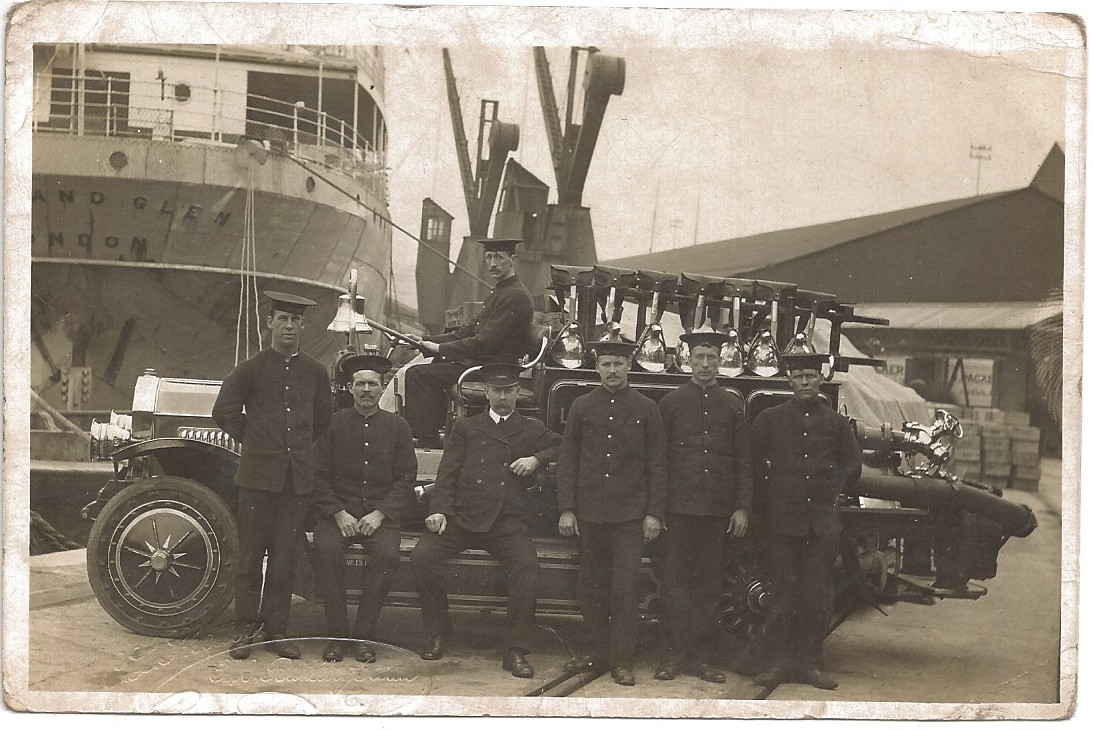
Evan George on fire engineThis photograph comes from a period of my grandfather’s life that I knew nothing about until recently. I had always assumed that Evan George went straight from Hescwm Farm, Dinas to an apprenticeship on the barque ‘Glance’ at Swansea and then, when that turned out to be a dead-end job, followed his older brother to London to work for the fire service. His fire-station, so I was told, was in Borough High Street, Southwark.

This photo, however, shows him, in East London’s docks. He is the fireman second from the left in the front row, seated on the board where I expect the men rested their feet when they were speeding to a fire. They must have sat up high where the helmets are shining.

The ship you can see in the background, SS Highland Glen, was built in Glasgow in 1910 to trade with Argentina, which at the time was one of the 10 richest counties in the world, attracting so many European immigrants that in 1914, half of the population of Buenos Aires was foreign born. The SS Highland Glen was built for the meat trade and carried both passengers and cargo from London to Buenos Aires and back until she sustained fire damage in the East India Dock in 1933. By that time, however, my grandfather had moved on.

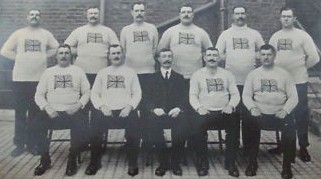
Britsh olympic Tug of War team 1912-1913The photo of my grandfather and his work colleagues was taken by George L Shotter, who worked from his shop at 340 Barking Road, London E, now E13. George Shotter also photographed the British tug-of-war team that won a silver medal in the Swedish Olympics of 1912. Click here for more photos.

Posted in History, Transport | Tagged , , , , | Leave a comment